Native Salesforce WhatsApp Integration
Manage two-way WhatsApp conversations directly inside Salesforce Lightning. Align WhatsApp Business API messaging with record-level visibility, structured routing, template governance, and full administrative control across sales and service teams.
Built for Salesforce teams managing WhatsApp conversations at scale under Meta policy and CRM governance standards.
Why Salesforce WhatsApp Conversations Break at Scale
WhatsApp works exceptionally well for one-to-one conversations. It breaks when multiple teams, regions, and customer records are involved. Without structured integration into Salesforce, WhatsApp communication becomes fragmented, unmanaged, and difficult to govern under Meta’s Business API policies.
Personal Devices and Unofficial Usage
Many teams begin using the WhatsApp Business App or personal devices to communicate with customers. Conversations remain tied to individual phones rather than CRM records.
Without structured integration:
- Messages are not logged on Leads, Contacts, or Cases
- Ownership is unclear during employee transitions
- Business communication lives outside Salesforce visibility
WhatsApp becomes dependent on individuals instead of systems.
No Structured Ownership or Routing
When WhatsApp is not embedded inside Salesforce, inbound conversations are handled manually or through shared devices. There is no alignment with record ownership, queues, or CRM workflows.
As volume increases:
- Multiple agents may respond to the same conversation
- Messages go unanswered during handoffs
- No consistent accountability exists
Conversational messaging requires routing discipline, not just delivery capability.
Meta Policy and Session Management
WhatsApp Business API introduces structured messaging rules, including template approvals and 24-hour session windows. Without centralized management, teams struggle to enforce compliance consistently.
Common breakdowns include:
- Sending messages outside approved templates
- Confusion around session expiration rules
- Limited oversight into opt-in status
Policy enforcement becomes reactive instead of systematic.
As conversational volume grows, unmanaged WhatsApp usage creates visibility gaps, ownership conflicts, and compliance exposure that compound over time.
Operational Control and Measurable WhatsApp Performance
WhatsApp inside Salesforce is not just a messaging channel. It becomes an accountable, trackable operational layer. Structured conversation management ensures that ownership, response timing, and engagement performance are visible across sales and service teams.
Structured Conversation Ownership
Response Performance Tracking
Template and Session Discipline
Unified Engagement Reporting
Structured Conversation Ownership
Every WhatsApp thread is assigned to a defined owner within Salesforce. Conversations are not handled through shared devices or unmanaged inboxes.
What This Enables
- Clear responsibility per Lead, Contact, or Case
- Consistent handoffs across teams
- Reduced duplicate responses
WhatsApp conversations follow ownership rules rather than individual devices.
Response Performance Tracking
Response behavior is measurable directly within Salesforce reporting. Managers can monitor first response time, conversation activity, and engagement consistency.
What This Enables
- Visibility into response timing by user or team
- Identification of delayed follow-ups
- SLA monitoring for conversational channels
WhatsApp becomes a measurable performance channel, not an informal chat tool.
Template and Session Discipline
WhatsApp Business API messaging operates under template approvals and 24-hour session rules. Structured management ensures teams operate within these boundaries consistently.
What This Enables
- Approved template usage control
- Session window awareness
- Reduced policy violations
Conversational freedom operates within defined messaging rules.
Unified Engagement Reporting
WhatsApp activity is visible alongside pipeline, service, and lifecycle data inside Salesforce dashboards.
What It Delivers
- Correlation between conversations and opportunity movement
- Engagement analysis across teams
- Conversation volume tracking over time
WhatsApp engagement becomes part of CRM performance visibility.
How WhatsApp Integrates Natively with Salesforce
Salesforce WhatsApp integration operates through the WhatsApp Business API while embedding conversation data, routing logic, and execution controls directly into Salesforce Lightning. Messaging infrastructure aligns with CRM objects, automation frameworks, and administrative configuration rather than existing as an external inbox.
WhatsApp Business API Connectivity
Communication is established through approved WhatsApp Business API connections. Message delivery, status updates, and inbound events are synchronized directly into Salesforce.
Technical Characteristics
- Official Meta Business API integration
- Inbound and outbound webhook handling
- Message status synchronization
- Business number verification support
WhatsApp operates through official API infrastructure rather than consumer applications.
Lightning-Embedded Chat Interface
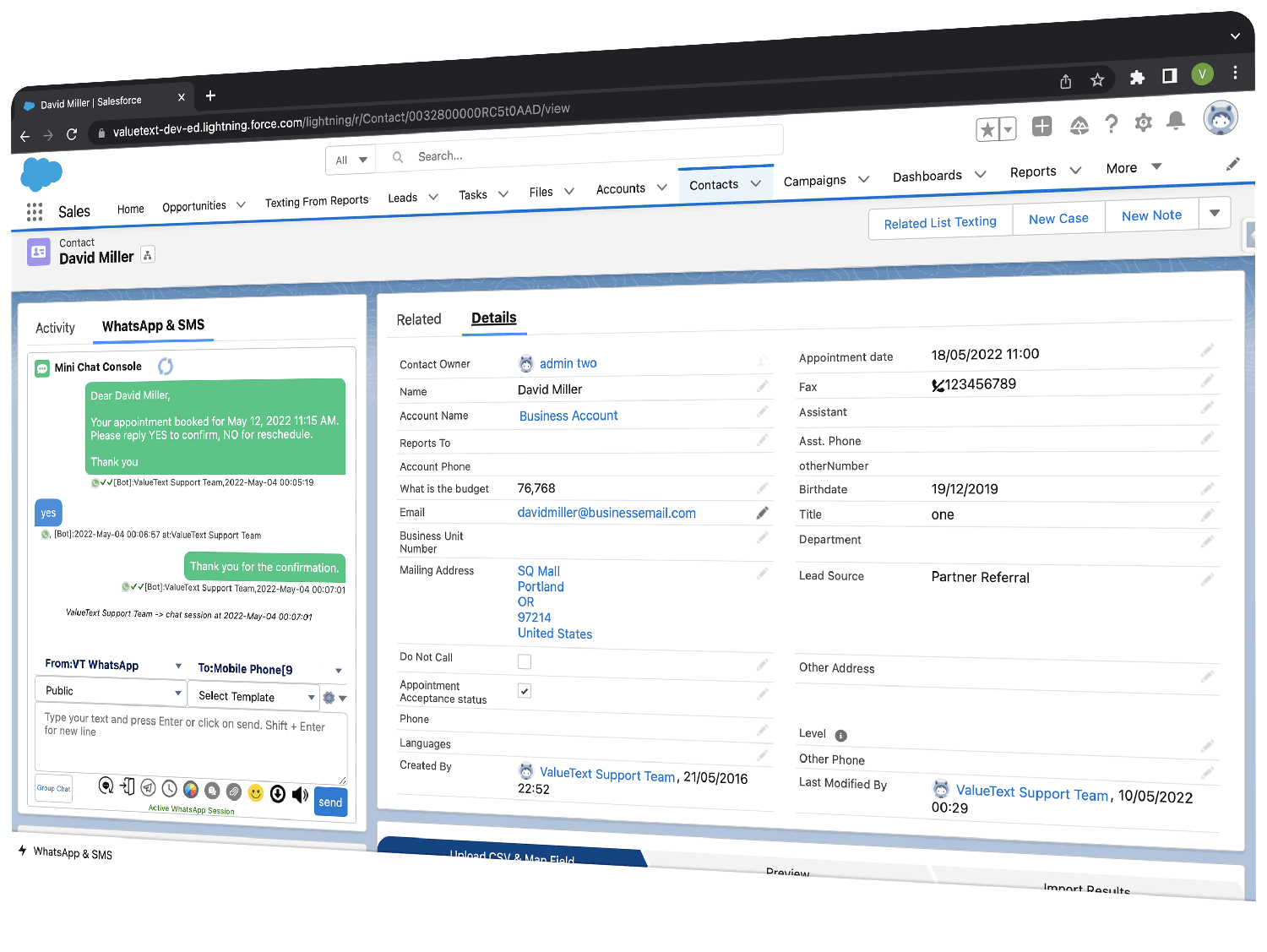
Conversations are managed within the Salesforce Lightning interface through an embedded chat console aligned with CRM records.
Technical Characteristics
- Chat console embedded in Lightning pages
- Record-linked conversation panels
- Multi-object compatibility
- Unified SMS and WhatsApp interface support
Messaging is executed within Salesforce UI architecture.
Template Approval & Session Enforcement
WhatsApp template messages and 24-hour session rules are managed through structured configuration aligned with Meta policies.
Technical Characteristics
- Template submission and approval tracking
- Session window enforcement logic
- Out-of-window template fallback handling
- Consent verification checks
Policy alignment is managed at the system level, not user discretion.
CRM-Aligned Data & Metadata Capture
Conversation content, timestamps, sender metadata, and delivery status are stored within Salesforce reporting and object structures.
Technical Characteristics
- Record-level message storage
- Delivery and read status tracking
- Custom object compatibility
- Dashboard-ready reporting fields
Conversation data resides within CRM governance layers.
WhatsApp Business API Connectivity
Lightning-Embedded Chat Interface
WhatsApp Template Approval
CRM-Aligned Data
Business Impact of Structured WhatsApp Inside Salesforce
When WhatsApp operates natively inside Salesforce, it becomes more than a messaging channel. It supports real-time engagement, persistent relationship management, and structured conversational workflows that directly influence sales velocity and customer retention.
Persistent Sales Conversations
Sales teams can maintain ongoing WhatsApp conversations directly within Salesforce, preserving context across opportunity stages and ownership transitions.
What This Enables
- Conversation continuity throughout the sales cycle
- Reduced reliance on fragmented email threads
- Structured follow-ups within CRM records
Customer conversations move with the opportunity, not with the device.
Centralized Support Interactions
Service teams manage WhatsApp inquiries within Salesforce, ensuring cases, escalations, and conversation history remain unified under a single customer record.
What This Enables
- WhatsApp case conversations tied to service records
- Consistent client communication across teams
- Clear escalation visibility
Support communication becomes CRM-governed rather than inbox-driven.
Measurable Engagement Signals
WhatsApp interaction volume, response behavior, and conversational activity become visible within Salesforce dashboards alongside pipeline and service metrics.
What It Enables
- Engagement tracking across sales and service
- Correlation between conversation activity and deal progression
- Visibility into communication intensity by region or team
Conversational activity becomes part of measurable CRM performance.
Scalable International Communication
WhatsApp is widely adopted across global markets, and Salesforce-native integration enables structured cross-border communication without separate tools per region.
What It Enables
- Region-based number management
- Unified global reporting
- Consistent conversational standards across markets
Global WhatsApp communication aligns with a single Salesforce architecture.
Salesforce WhatsApp transforms real-time conversations into structured CRM engagement that supports pipeline progression, service continuity, and long-term customer relationships.
Governance for Salesforce WhatsApp Deployments
WhatsApp Business API messaging operates under structured Meta policies, approved template frameworks, and session-based delivery rules. Effective deployment inside Salesforce requires centralized governance to ensure conversations remain compliant, traceable, and aligned with administrative controls.
Template & Conversation Governance
Outbound WhatsApp communication depends on approved templates and defined session windows. Governance ensures template usage and conversation boundaries are consistently enforced across users and teams.
• Template approval lifecycle visibility
• Out-of-session template enforcement
• Structured fallback handling for expired sessions
• Reporting on template usage activity
Business Account & Number Control
WhatsApp Business API requires verified business accounts and structured number management. Governance ensures messaging remains tied to approved business identities rather than individual devices.
• Centralized business number management
• User-level sending permissions
• Controlled access to WhatsApp accounts
• Removal of personal-device dependency
Session & Consent Oversight
WhatsApp enforces 24-hour session windows and consent-based communication boundaries. Governance ensures outbound messaging aligns with both Meta policy and CRM consent status.
• 24-hour session tracking
• Opt-in visibility at record level
• Session-based outbound restrictions
• Audit-ready conversation retention
System-Level Meta Rule Enforcement
Meta messaging rules are embedded within Salesforce configuration layers rather than managed manually.
- Template validation before send
- Session boundary detection
- Message-type classification logic
- Automatic restriction of non-compliant sends
Policy compliance operates at the system layer.
Role-Based WhatsApp Access
Access to WhatsApp conversations and sending privileges follows Salesforce role hierarchy and profile configuration.
- Profile-based send permissions
- Role-aligned conversation visibility
- Controlled template access
- Administrative override capability
Access control inherits Salesforce security structures.
Structured Audit Visibility
Conversation history, template usage, and session activity are retained within Salesforce reporting structures for oversight and internal review.
- Template usage reporting
- Session compliance tracking
- Conversation audit retention
- Administrative export capability
WhatsApp activity remains transparent within CRM governance.
Salesforce WhatsApp operates within Meta policy rules and CRM governance frameworks rather than unmanaged device-based messaging practices.
Trusted for Salesforce WhatsApp Deployments
From sales-driven organizations to service-led teams operating across markets, ValueText enables structured WhatsApp communication inside Salesforce. Teams use it to manage Business API messaging, maintain record-level visibility, and align conversational engagement with CRM governance.






Real Estate
Improved communication consistency across high-volume sales and rental workflows.
- Scaled automations for inbound and outbound funnels
- Maintained fast, structured client communication
- Optimized workflows to support growth without operational
Mission-critical messaging centralized inside Salesforce.

Victoria Valle
Team Leader at Luxion Homes
Retail & Vending
Reduced response time from days to minutes by moving communication to structured SMS and WhatsApp inside Salesforce.
- Transitioned from traditional channels to embedded messaging
- Improved client engagement immediately after go-live
- Eliminated long response delays
Response cycles shifted from reactive to real-time.
Daniel Jarzembowski
CEO at Svea Polska sp. z o.o.
Semiconductor Software
Improved engagement metrics by centralizing WhatsApp automation inside Salesforce.
- Increased engagement without added operational complexity
- Automated customer messaging workflows
- Unified communication across subsidiaries
Automation delivered measurable engagement lift.

Michael Lamb
Developer at Bluespec
Native Salesforce WhatsApp vs External Messaging Approaches
If Salesforce is your system of record, your WhatsApp communication layer should align with the same architectural standards. The difference between native WhatsApp integration and external tools is not message delivery. It is structural alignment, policy enforcement, and CRM continuity.
Selecting a native WhatsApp integration is about how conversational messaging integrates with your CRM architecture, Meta policy requirements, and operational governance.

WhatsApp Business App & Device-Based Usage
Many teams begin with the WhatsApp Business App or WhatsApp Web. While effective for one-to-one conversations, these tools are designed for device-based usage rather than structured CRM integration.
Structural Characteristics:
- Conversations tied to individual devices
- No record-level CRM visibility
- Manual copy-paste into Salesforce
- Limited ownership continuity
- No structured routing across teams
- Meta policy managed manually
Business communication depends on individuals rather than systems.

Salesforce-Native WhatsApp (ValueText)
ValueText embeds WhatsApp Business API messaging directly inside Salesforce Lightning, aligning conversations with CRM objects, ownership logic, and governance frameworks.
Structural Characteristics:
- Record-level conversation storage on standard and custom objects
- Embedded Lightning chat console
- Role-based routing aligned with Salesforce hierarchy
- Template and session governance built into CRM workflows
- Unified reporting within Salesforce dashboards
- No cross-system data reconciliation
WhatsApp operates within Salesforce architecture rather than alongside it.
Salesforce Digital Engagement
Salesforce Digital Engagement enables multi-channel communication across Service Cloud and related environments. It supports WhatsApp but is designed for broader digital orchestration rather than structured WhatsApp-first conversational management.
Structural Characteristics:
- Multi-channel configuration
- Enterprise-tier licensing structure
- Layered routing and configuration setup
- Designed primarily for service workflows
- Broader orchestration capabilities beyond WhatsApp
Powerful for large-scale digital service environments, but often more complex than required for structured WhatsApp-driven sales and support conversations.
Selecting a messaging approach is not about sending messages. It is about how messaging aligns with your CRM architecture, governance requirements, and operational model.
Designed for Salesforce-Centric Organizations
Salesforce-native SMS is not intended to replace lightweight texting tools. It is built for organizations where Salesforce governs revenue workflows, customer records, and operational reporting. Messaging is expected to function within CRM standards rather than alongside them.
This Platform Is Built For
- Organizations where Salesforce serves as the system of record
- Teams that require conversation traceability within CRM objects
- Administrators managing automation through Salesforce Flow
- Revenue and service teams operating under SLA or compliance constraints
- Businesses with multi-user access, role hierarchies, and structured ownership models
- Environments where messaging must align with reporting and governance standards
Messaging supports CRM execution rather than operating as a parallel communication channel.
Not Designed For
- Businesses using Salesforce only for limited data storage
- Teams seeking a standalone WhatsApp marketing application
- Organizations without structured routing or ownership requirements
- Low-volume texting use cases without reporting dependency
- Workflows managed primarily outside Salesforce
This solution is designed for structured Salesforce environments, not ad-hoc texting needs.
Your Salesforce CRM Should Not Depend on External WhatsApp Layers
Unify WhatsApp, automation, routing, and governance directly inside Salesforce. Replace disconnected tools with structured messaging aligned to your CRM architecture.